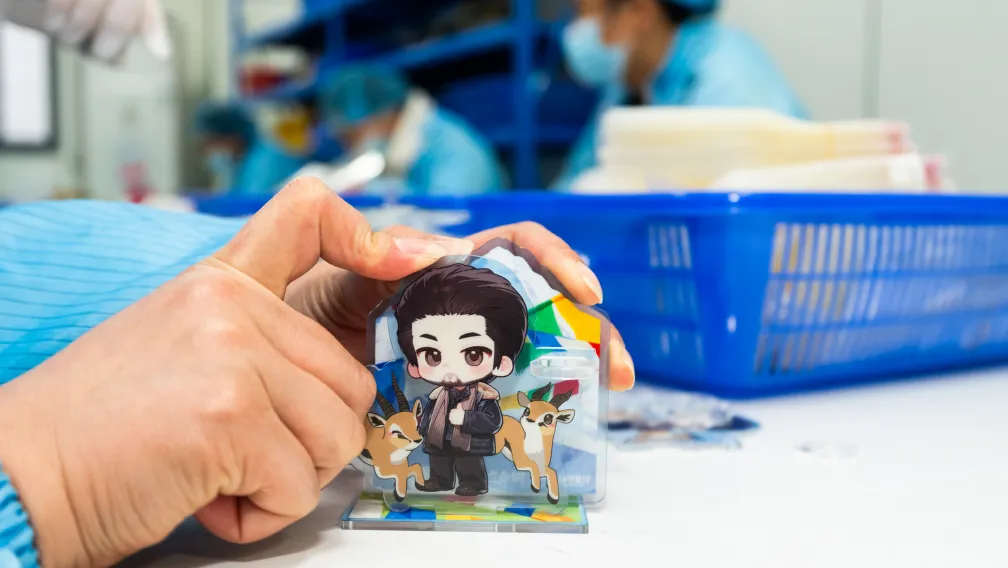
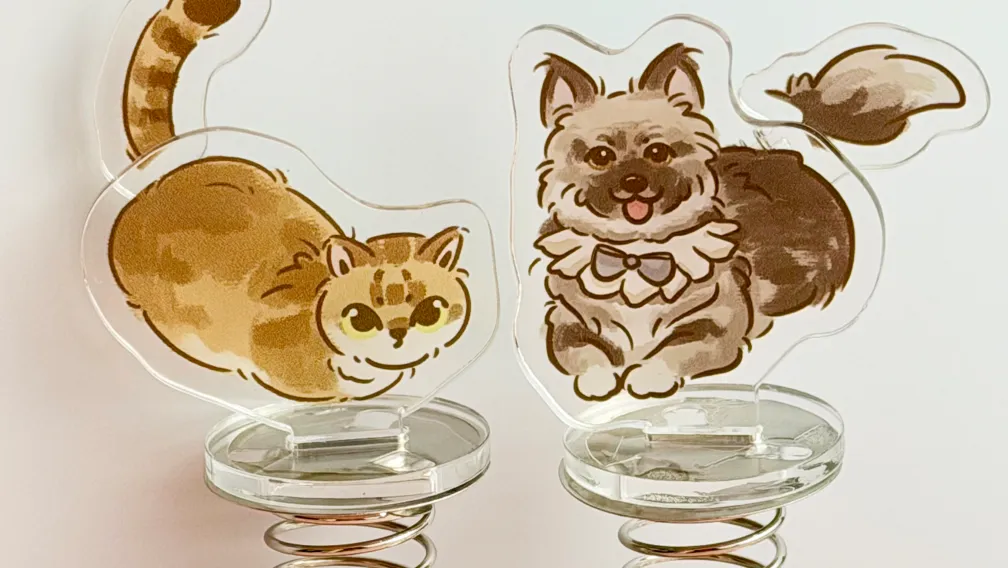
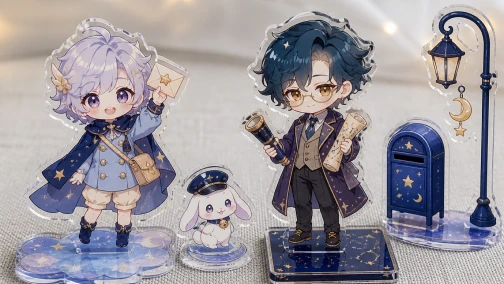
Custom liquid shaker acrylic stickers combine high-resolution UV printing, precision-cut cast acrylic, and dynamic floating elements to create interactive merchandise. As a direct manufacturer operating a 1500m² audited facility, we engineer these items using ultrasonic sealing technology to encapsulate non-toxic liquid and custom glitter securely. This process ensures a leak-proof, scratch-resistant product suitable for IP merchandising, retail stationery, and promotional campaigns.
We provide full structural support, validating cut lines, cavity dimensions, and adhesive strength on a digital proof prior to bulk manufacturing, ensuring uniform quality across your entire order volume.


Define the physical attributes of your custom liquid shaker stickers. Each specification is reviewed by our prepress team and confirmed on a digital proof before manufacturing begins.
Standard dimensions range from four to eight centimeters, utilizing a multi-layer acrylic structure to form the internal liquid cavity while maintaining a manageable overall profile.
Die-cutting parameters accommodate any vector silhouette. Our prepress team verifies the artwork to ensure the internal chamber leaves sufficient border width for a secure ultrasonic seal.
Select from a wide range of inner fillers, including metallic stars, holographic hearts, colored beads, and custom-shaped micro-acrylic confetti, suspended in a safe, non-toxic clear oil.
Artwork is standardly printed on the reverse side of the front and back layers (sub-surface printing) to protect the ink and create a multi-dimensional backdrop for the floating glitter.
Equipped with industrial-grade 3M adhesive backings, ensuring the shaker sticker bonds permanently to smooth surfaces like plastic, glass, and sealed paper without edge peeling.
Orders can be delivered in bulk flat packs or individually packaged in OPP bags with custom-printed backing cards tailored for immediate retail display.
| SPECIFICATION | DETAILS |
|---|---|
| MATERIAL | Cast acrylic (PMMA) sheet — high clarity, resists yellowing, multi-layer structure |
| INTERNAL FILL | Non-toxic clear mineral oil with custom glitter, sequins, and mini acrylic confetti |
| SEALING METHOD | Industrial ultrasonic welding for leak-proof, hermetic encapsulation |
| DIMENSIONS | Standard sizes from four to eight centimeters; custom sizing available upon request |
| PRINTING | High-resolution UV printing with opaque white ink underbase; sub-surface protected |
| CUTTING | CNC precision engraving for exact cavity depth and outer vector silhouettes |
| ADHESIVE | High-tack 3M industrial double-sided adhesive backing for smooth surfaces |
| MOQ | Flexible volume processing; exact quantity confirmed based on custom cavity design |
| ARTWORK FILES | PSD, AI or PNG at print resolution, transparent background required |
| PROOFING | Digital proof providing cut lines, cavity boundaries, and print configuration |
| COMPLIANCE | CE Certification, EU RoHS Directive compliant, manufactured in a BSCI audited facility |
| PACKAGING | Individual OPP bags with protective surface film; custom retail backing cards optional |
Commercial buyers require absolute certainty regarding leak prevention, optical clarity, and adhesive reliability before confirming an order for liquid-filled merchandise. This section outlines the structural details and processing standards that define our custom liquid shaker stickers.
The primary concern with any liquid-filled acrylic product is fluid retention. We construct the internal cavity using a precisely routed middle acrylic layer. Once the custom glitter and non-toxic mineral oil are inserted, the top and bottom PMMA panels are fused using ultrasonic welding technology. This creates a seamless, hermetic seal that withstands daily handling, mild drops, and transit pressure without leaking or cracking.
We strictly utilize cast polymethyl methacrylate (PMMA) rather than extruded plastics. Cast acrylic maintains high light transmission and resists UV degradation, ensuring the liquid and glitter inside remain perfectly visible without the yellowing effect common in lower-grade plastics. Artwork is applied via UV-cured printing, typically on the interior-facing surfaces. This technique protects the ink behind a solid acrylic shield, making the design fully scratch-resistant.
Panels undergo CNC precision engraving to execute both the external silhouette and the internal liquid chamber. CNC routing is deployed for these multi-layered components because it requires exact depth tolerances to maintain structural balance. The method ensures that the approved silhouette is reproduced without burrs or micro-fractures, maintaining uniformity across bulk orders.
To guarantee consistency across different production runs, we archive all approved digital proofs, cut-line vectors, cavity dimensions, and color management profiles. When clients initiate a repeat order, the exact machine parameters are retrieved. This systematic archiving is particularly critical for merchandise distributors and IP licensors who rely on exact color matching and structural uniformity across sustained retail campaigns.
Liquid-filled shipments require calculated packaging to prevent abrasion and manage pressure during transit. Each shaker sticker is individually sealed in an OPP bag, with a protective film left on the acrylic face for the end-user to remove. For retail readiness, we manufacture custom-printed backing cards, blister packs, and branded display boxes, allowing the product to move directly from the shipping carton to the retail shelf.
Sourcing customized liquid-filled adhesive products for retail, corporate merchandising, or IP distribution requires a concrete understanding of substrate properties, encapsulation technologies, and compliance standards. This guide details the technical specifications and procurement considerations necessary to execute a successful custom liquid shaker acrylic sticker project.
The primary material utilized in high-quality acrylic stickers is Polymethyl Methacrylate (PMMA), commonly referred to as cast acrylic. Unlike extruded acrylic, which is manufactured by pushing the heated polymer through a die, cast acrylic is produced by pouring liquid resin into molds. This casting process results in a substrate with superior optical clarity, a higher molecular weight, and excellent resistance to surface crazing during CNC machining. For liquid display applications, cast acrylic ensures that the transparent layers remain free of optical distortion, allowing the internal fluid and glitter to be viewed perfectly while resisting UV-induced yellowing over long-term exposure to ambient light.
The transition from a digital artwork file to a physical liquid shaker sticker involves several precise, sequential manufacturing phases.
Pre-Press and Cavity Engineering: Digital files undergo pre-flight checks to establish vector cutlines and verify CMYK color profiles. Crucially for shaker products, our engineers map out the internal liquid cavity. A precise border width must be maintained between the inner cavity edge and the outer silhouette to ensure there is sufficient surface area for a secure ultrasonic seal.
High-Resolution UV Printing: The artwork is applied directly to the acrylic substrate using industrial UV flatbed printers. A critical component of this phase is the application of a white ink underbase. Because acrylic is naturally transparent, the white layer acts as a necessary barrier, ensuring that the CMYK colors appear opaque and saturated. The UV curing process utilizes ultraviolet light to instantly polymerize the ink, creating a durable layer that bonds molecularly with the PMMA surface.
Ultrasonic Welding and Fluid Injection: This is the defining step for liquid shaker products. The structure consists of a printed back panel, a thick middle spacer panel with a routed cavity, and a clear front panel. Once the custom glitter and non-toxic mineral oil are injected into the cavity, the layers are subjected to ultrasonic welding. High-frequency acoustic vibrations generate localized heat, melting and fusing the acrylic layers together seamlessly. This hermetic seal is vastly superior to standard glues, eliminating the risk of fluid leakage.
The functional application of a sticker depends on its adhesive backing. We utilize industrial-grade, pressure-sensitive adhesives (such as 3M series tapes) applied to the rear panel.
These adhesives are selected for their high initial tack and long-term shear strength, ensuring the relatively heavy, multi-layered liquid sticker remains securely fastened to smooth surfaces like mobile phone cases, laptop lids, and retail packaging without edge curling or delamination under normal temperature fluctuations.
Standardized quality control protocols are essential for maintaining consistency, especially for fluid-filled merchandise. Inspections occur at multiple stages. Initially, the raw substrate is checked for gauge tolerance and surface blemishes. During printing, color accuracy is monitored against approved digital proofs. The most rigorous testing occurs post-assembly: every sealed unit is subjected to pressure and orientation testing to verify the integrity of the ultrasonic weld and ensure zero leakage. Final checks confirm the smooth movement of the internal glitter and the correct alignment of the adhesive backing.
B2B procurement necessitates strict adherence to international safety and environmental regulations. Liquid acrylic products manufactured for global distribution must comply with several critical directives.
Material and Fluid Safety: The PMMA substrates, UV inks, adhesives, and the internal mineral oil utilized must be non-toxic and free of restricted hazardous compounds. This complies with the EU RoHS directives (Directive 2015/863 & 2011/65/EU). Independent laboratory testing and CE certification documentation validate this compliance for customs and retail distribution.
Facility Audits: Ethical manufacturing is validated through comprehensive facility audits. Certifications such as the amfori BSCI (Business Social Compliance Initiative) demonstrate a manufacturer's verified commitment to fair labor practices, occupational health, and safety standards. Selecting a supplier with these credentials mitigates supply chain and reputational risks for international brands and IP licensors.
Proper packaging is critical to preventing surface abrasions and managing pressure changes during air or sea transit. Individual liquid shaker stickers are typically housed in protective OPP bags. A protective electrostatic film is left on the front surface of the acrylic, which the end-user peels off prior to display. For retail environments, custom-printed backing cards with hang holes and rigid blister packs are utilized. During bulk transit, cartons are packed tightly with impact-absorbing materials to prevent the rigid acrylic layers from cracking under transit shock.
Buyers frequently evaluate complex shaker merchandise against standard flat alternatives. The following table outlines the technical differences to aid in product selection for procurement projects.
| Parameter | Liquid Shaker Acrylic Sticker | Standard Flat Acrylic Sticker | Vinyl/Paper Sticker |
|---|---|---|---|
| Structure | Multi-layer PMMA with internal fluid cavity | Single-layer flat PMMA panel | Ultra-thin flexible film or paper |
| Visual & Interactive Effect | High; features 3D depth and dynamic moving glitter | Moderate; rigid and glossy but static | Low; completely flat and static |
| Thickness | Thick (typically 6mm - 9mm) | Thin (typically 2mm - 3mm) | Negligible (under 0.5mm) |
| Manufacturing Complexity | High; requires CNC routing, fluid injection, and ultrasonic welding | Low; requires basic UV printing and laser/CNC cutting | Very Low; roll-to-roll printing and die-cutting |
| Retail Value Perception | Premium collectible; commands highest retail margin | Mid-tier merchandise | Standard promotional item |
Identifying a reliable factory partner for liquid-filled merchandise involves evaluating their encapsulation technologies and quality control protocols. A fully equipped manufacturer handles all core stages in-house—from CNC cavity routing and UV printing to ultrasonic sealing and final assembly. This vertical integration reduces lead times, strictly controls the hermetic sealing process to prevent leakages, and ensures consistent quality control. Furthermore, the capacity to process flexible batch sizes, ranging from initial prototype sampling to high-volume commercial production, provides necessary scalability for merchandise distributors and enterprise procurement teams.