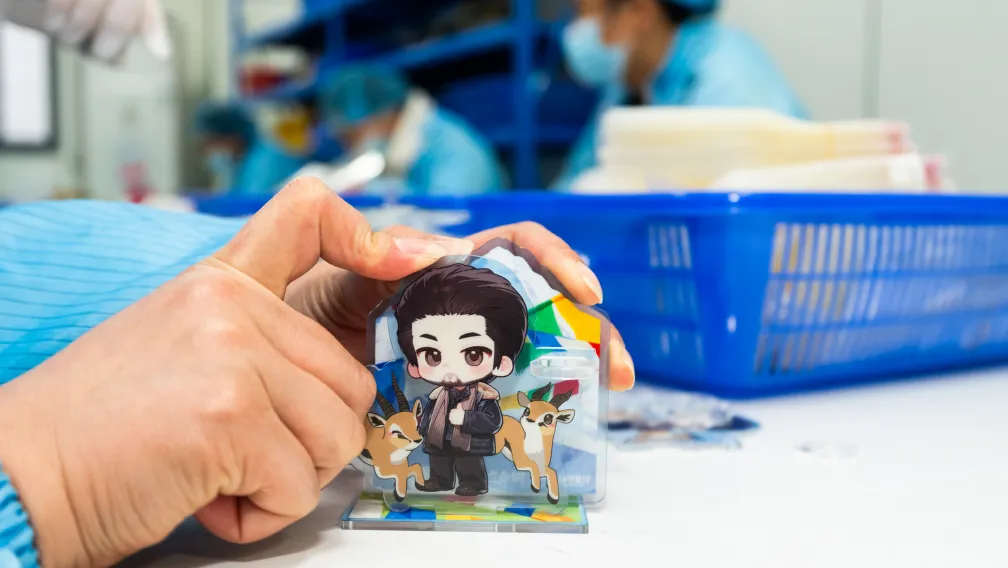
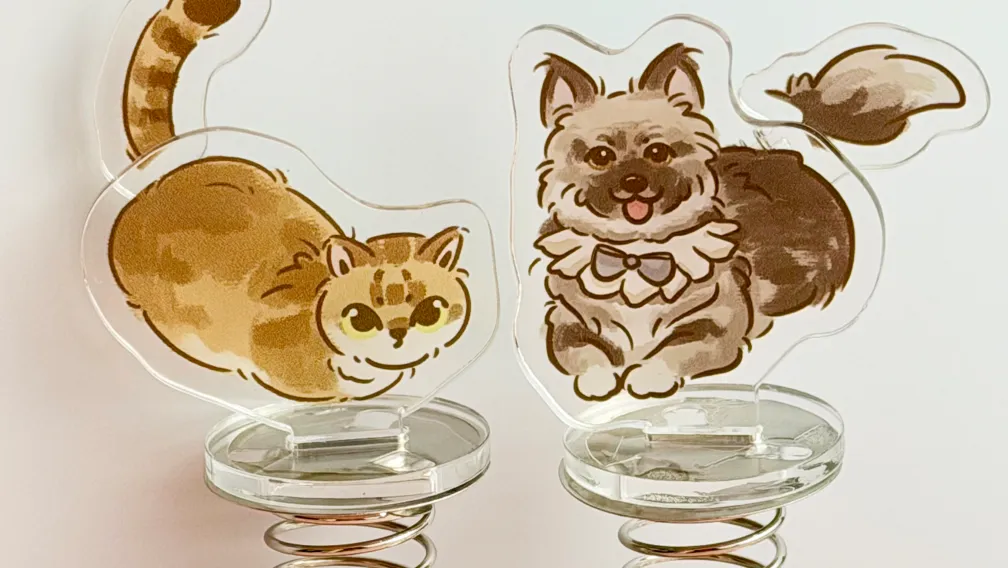
Custom jelly stickers, frequently categorized as soft touch decompression stickers or thickened relief stickers, introduce a distinct squishy, tactile volume to character and kawaii branding designs. These products are engineered by dispensing a highly flexible, clear polyurethane resin over high-resolution printed films. This composite structure ensures excellent visual fidelity while maintaining a soft, raised profile that yields to pressure and instantly rebounds during daily handling. The manufacturing process is highly adaptable, accommodating everything from intricate kiss-cut journaling (hand ledger) sheets to standalone interactive promotional configurations.
Modori Works manufactures custom thickened relief jelly stickers for anime artists, merchandise brands, stationery buyers, and retail programs. Jelly sticker production covers custom shapes, custom sizes, and bulk quantity programs, manufactured to exact project specifications.


A jelly sticker project is defined by six core decisions, and the approved digital proof records each one before manufacturing begins.
Individual sticker dimensions and overall sheet sizes are fully customizable. The resin dispensing volume is calibrated to control the exact height of the 3D thickened relief.
Die-cutting parameters accommodate complex vector silhouettes. Our prepress team verifies the artwork to ensure sharp corners and thin protrusions are adjusted to hold the liquid resin effectively before curing.
The standard finish is a high-gloss clear dome, but base layers can incorporate holographic vinyl, glitter, or foil stamping beneath the resin for enhanced visual impact.
Stickers can be arranged on custom-sized backing sheets. We optimize the layout to maximize the number of stickers per sheet while maintaining safe die-cutting margins.
Select from standard permanent adhesives for notebooks and crafts, or specialized adhesives suited for phone cases and electronic devices.
Orders can be delivered as bulk sheets or individually packaged in OPP bags with custom-printed backing cards tailored for immediate retail display.
| SPECIFICATION | DETAILS |
|---|---|
| MATERIAL | Highly plasticized soft polyurethane (PU) resin over printed vinyl |
| TEXTURE | Squishy, soft touch, decompression (pinch) tactile surface |
| SHEET SIZE | Fully customizable individual or backing sheet dimensions |
| PRINTING | High-resolution digital sub-surface printing (protected by resin layer) |
| CUTTING | Precision kiss-cut die-cutting calibrated for thickened soft substrates |
| BASE OPTIONS | Standard white vinyl, holographic film, or glitter vinyl bases available |
| ADHESIVE | High-tack permanent adhesive for multi-surface application |
| ARTWORK FILES | PSD, AI or high-res PNG; vector files strongly preferred |
| PROOFING | Digital proof providing cut lines, sheet layout, and design configuration |
| COMPLIANCE | Non-toxic materials, manufactured in a BSCI audited facility |
| PACKAGING | Individual OPP bags with optional custom retail backing cards |
Buyers usually ask how clearly artwork will print beneath a thickened resin layer, how resilient the squishy surface will remain, how cleanly the stickers peel from the sheet, and which choices affect reorders. These are the practical checks completed before a custom jelly sticker order ships.
Artwork is reviewed at the final sticker size before production. Small text and highly intricate lines are flagged on the proof. We use high-resolution digital printing techniques to ensure the colors remain vibrant and distinct beneath the clear, glossy dome of the soft polyurethane resin.
The soft resin layer is checked for consistent thickness and doming across the batch. High-quality plasticized polyurethane is utilized to ensure the surface provides the signature squishy, decompression feel while resisting permanent indentation or yellowing after daily handling and application.
The custom die-cut outline is checked against the artwork, and finished stickers are reviewed to ensure the blade cuts cleanly through the resin and adhesive layers while leaving the backing sheet intact. This guarantees a smooth, tear-free peel, even for complex kawaii silhouettes.
Approved artwork files, die-cut paths, and color references become the baseline for repeat orders, keeping reorders and new designs in the same stationery series consistent with the first run.
Project cost depends mainly on the overall sheet or sticker size, total quantity, outline complexity, and retail packaging requirements. Larger bulk runs significantly reduce the unit manufacturing cost.
Packaging is arranged per project, from simple bulk cartons to individually sealed OPP bags with custom backing cards for retail merchandise programs. Orders ship worldwide with tracking and robust export packing.
Sourcing customized soft touch adhesive products for retail stationery, hand ledger (journaling) supplies, or IP distribution requires a solid understanding of resin properties, sub-surface printing, and die-cutting standards. This guide details the technical specifications and procurement considerations necessary to execute a successful custom jelly sticker project.
The physical structure of a high-quality jelly sticker relies on a specific chemical formulation. The top layer is typically a highly plasticized polyurethane (PU) resin or a soft silicone-like compound. Unlike standard epoxy resin—which cures into a rigid, hard shell—or EVA foam—which compresses like a sponge—this soft PU material cures into a thick, highly pliable dome that yields to pressure and instantly rebounds. This creates the "decompression" or "pinch" tactile effect highly sought after in the kawaii merchandise and journaling markets. The resin must offer superior optical clarity to display the underlying artwork perfectly while resisting UV-induced yellowing over long-term exposure to ambient light.
The transition from a digital artwork file to a physical thickened relief sticker involves several precise, sequential manufacturing phases.
Pre-Press and Die-Cut Engineering: Digital files undergo pre-flight checks to establish vector cutlines and verify color profiles. For fluid-dispensed products, our engineers map out the die-cut boundaries with specific tolerances. Sharp internal angles must be adjusted to ensure the liquid resin flows evenly to the edge of the sticker and cures with a uniform domed meniscus before the kiss-cutting stage.
High-Resolution Sub-Surface Printing: Applying artwork beneath a clear layer requires precision. We utilize high-resolution digital printers to deposit ink onto a durable vinyl base. Because the artwork sits beneath the thick resin layer, it is entirely protected from physical abrasion, ensuring the colors remain vibrant and scratch-free during daily handling.
Resin Dispensing and Precision Die-Cutting: Once printed, the vinyl sheets pass through automated dispensing machinery that deposits exact micro-volumes of the soft PU resin over each design. The sheets are then cured in controlled thermal environments. Finally, custom-tooled cutting dies press through the composite layers. The machinery is precisely calibrated to cut cleanly through the soft resin and vinyl base while leaving the bottom release paper intact, resulting in a flawless kiss-cut sheet of stickers.
The functional application of a jelly sticker depends on its adhesive backing. We utilize industrial-grade, pressure-sensitive adhesives applied to the rear of the vinyl base. These adhesives are engineered for high initial tack, ensuring the relatively heavy, thickened sticker remains securely fastened to smooth surfaces like mobile phone cases, laptops, and paper notebooks without edge curling. The flexible nature of the jelly sticker allows it to conform slightly to curved surfaces better than rigid epoxy alternatives.
Standardized quality control protocols are essential for maintaining consistency in tactile merchandise. Inspections occur at multiple stages. During printing, color accuracy and resolution are monitored. Post-curing, the resin is checked for optical clarity, complete polymerization (ensuring the surface is squishy but not sticky), and absence of trapped air bubbles. The most rigorous testing occurs post-die-cutting: sheets are examined to verify that the cuts are completely severed, the soft edges show no distortion, and the individual stickers peel away smoothly from the release liner.
B2B procurement necessitates strict adherence to international safety and environmental regulations, especially since jelly stickers are frequently distributed in children's, kawaii, and stationery markets.
Material Safety: The PU resins, inks, and adhesives utilized must be non-toxic and free of restricted hazardous compounds such as phthalates and heavy metals. Compliance with relevant safety directives is mandatory. We maintain rigorous material testing protocols to facilitate secure international trade and retail distribution.
Facility Audits: Ethical manufacturing is validated through comprehensive facility audits. Certifications such as the amfori BSCI (Business Social Compliance Initiative) demonstrate a manufacturer's verified commitment to fair labor practices, occupational health, and safety standards. Selecting a supplier with these credentials mitigates supply chain and reputational risks for international brands.
| Parameter | Jelly / Decompression Sticker | Puffy / EVA Foam Sticker | Epoxy Dome Sticker |
|---|---|---|---|
| Structure | Soft PU resin domed over printed vinyl | Printed film over EVA foam core | Hard epoxy resin domed over printed vinyl |
| Tactile Profile | Squishy, yielding, instant rebound | Spongy, compressible 3D relief | Hard, rigid, smooth convex surface |
| Surface Finish | High gloss, transparent | Matte, glossy, or holographic film | High gloss, transparent |
| Flexibility | Very High; bends easily with surfaces | High; flexes with substrate | Very Low; rigid dome restricts bending |
| Retail Perception | Kawaii, interactive, premium journaling | Playful, dimensional merchandise | Premium branding, equipment labels |
Identifying a reliable factory partner for thickened relief adhesive merchandise involves evaluating their resin dispensing adaptability and die-cutting precision. A fully equipped manufacturer handles all core stages in-house—from vinyl printing and automated resin dispensing to custom tooling and packaging. This vertical integration reduces lead times, strictly controls the curing parameters of the soft resin to prevent stickiness or yellowing, and ensures consistent quality. Furthermore, the capacity to process flexible batch sizes provides the necessary scalability for merchandise distributors and enterprise procurement teams.