Stickers are the highest-velocity SKU in most anime merchandise and promotional programs. They sell at low unit prices, attach to nearly every product launch, and move in volumes that expose manufacturing weaknesses fast. A misjudged material specification or an ambiguous cut instruction does not produce a slightly worse sticker; it produces ten thousand pieces of unsellable inventory. This guide consolidates the technical decisions a buyer must lock down before a custom vinyl sticker order enters production: substrate selection, ink systems, cut format, lamination, adhesive specification, and the verification steps that confirm a factory actually controls them.
Substrate Selection: Why PVC Vinyl Dominates Merchandise Programs
Three substrate families cover most of the commercial sticker market: paper, BOPP (biaxially oriented polypropylene), and PVC vinyl. Paper suits short-life indoor labels and low-cost packaging seals. BOPP offers good moisture resistance for food and cosmetic labeling. PVC vinyl is the correct default for merchandise, laptop, bottle, and outdoor applications because it combines flexibility, printability, and multi-year environmental resistance in a single film.
Within PVC vinyl, the manufacturing method splits into two grades with measurably different behavior. Calendered vinyl is formed by pressing heated PVC compound through rollers, a process that stretches the film and leaves internal tension in the material. That tension releases under heat and UV exposure, causing gradual shrinkage and edge lifting over a service life typically rated at one to five years outdoors. Cast vinyl is produced by pouring liquid resin onto a casting sheet and curing it without mechanical stretching, which yields a dimensionally stable film roughly 2 mil thick with outdoor service ratings of seven to ten years and far better conformability over curved surfaces such as bottles, helmets, and equipment housings.
For merchandise programs, laminated premium calendered vinyl at 3 to 4 mil covers the majority of laptop, bottle, and packaging applications at the correct price point. Cast film earns its premium when the sticker must survive on curved or outdoor-exposed surfaces for years, or when dark, full-coverage artwork will absorb solar heat and accelerate the shrinkage of lesser films.
Ink Systems and Color Stability
Print durability is governed by the ink chemistry and its bond to the film. Solvent, eco-solvent, and UV-curable inks are the standard choices for outdoor-rated vinyl because the pigment system penetrates or cross-links with the film surface and resists fading under UV exposure. Water-based inkjet output without lamination is an indoor product regardless of the substrate beneath it. Programs specifying transparent or holographic films additionally require a white ink underbase printed beneath the CMYK layer; without it, colors turn translucent and shift against whatever surface the sticker is applied to. The registration discipline involved is the same one applied to custom acrylic keychains, where white underbase alignment within a fraction of a millimeter determines whether line art prints clean.
Die-Cut vs. Kiss-Cut: The Format Decision
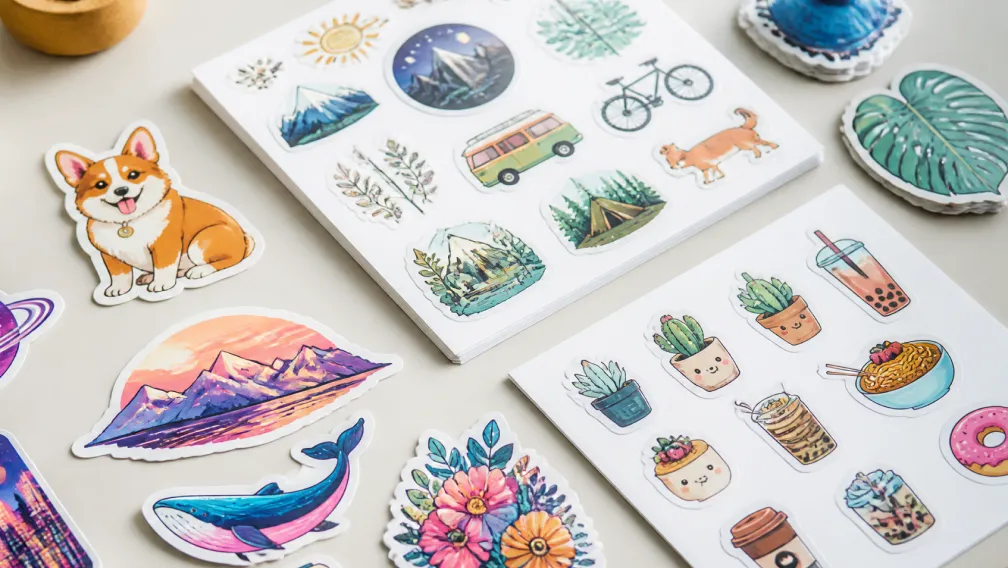
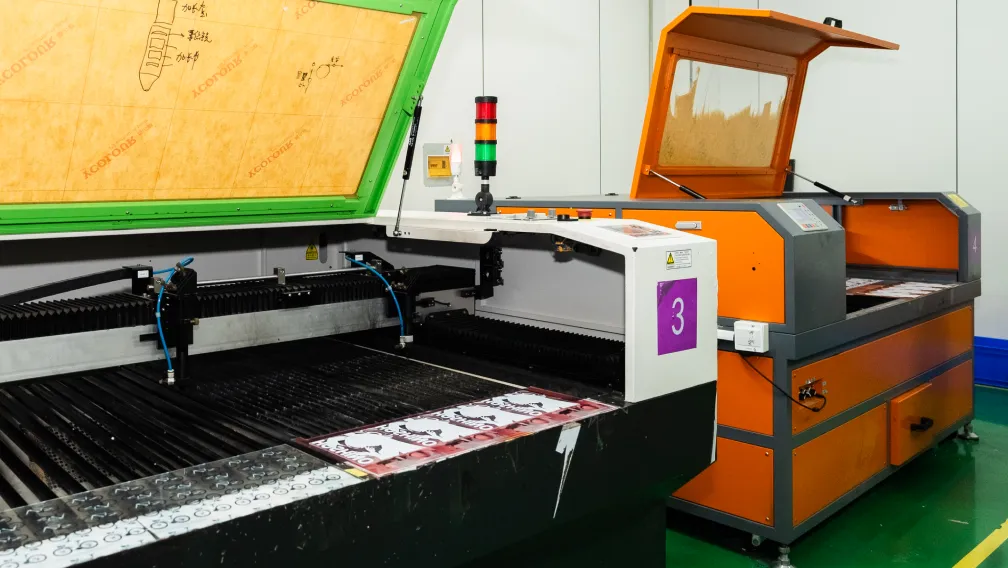
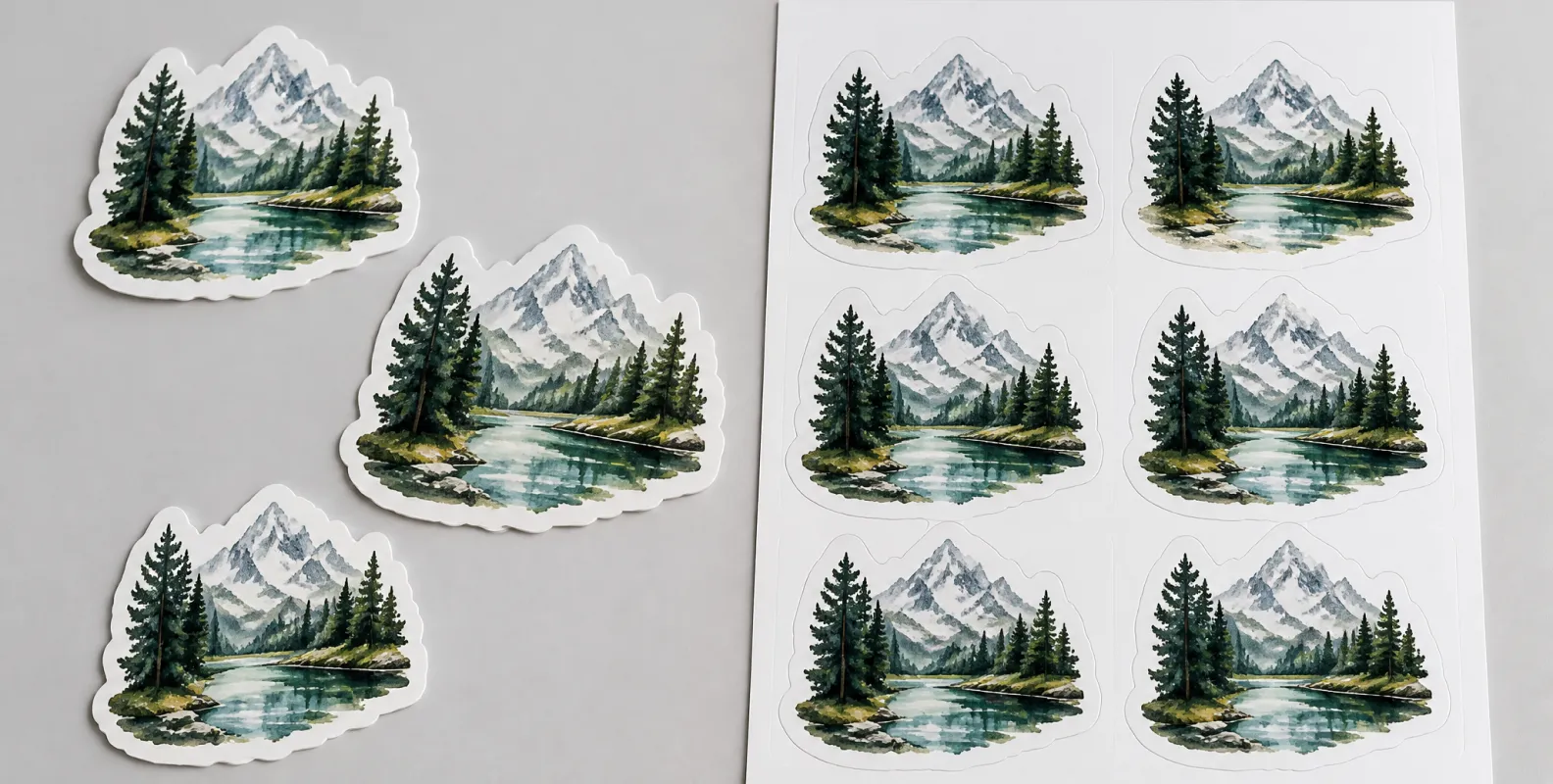
Both formats are produced on the same digital cutting equipment, and both follow the exact contour of the artwork. The difference is cut depth. A die-cut pass drives the blade through the vinyl film, the adhesive, and the backing paper, so each piece emerges as an individual sticker whose backing matches its outline. A kiss-cut pass cuts through the vinyl and adhesive only, leaving the backing sheet intact, so the sticker peels away from a larger square or rectangular carrier.
Once applied, the two formats are indistinguishable. The commercial difference is everything that happens before application:
| Parameter | Die-Cut | Kiss-Cut |
|---|---|---|
| Cut depth | Through film, adhesive, and backing | Through film and adhesive only |
| Delivered format | Individual pieces | Pieces on a backing sheet or card |
| Peel experience | Peel from the sticker's own edge | Wide backing border acts as a peel handle |
| Multi-design sheets | Not possible | Standard format for sticker packs |
| Transit protection | Edges exposed; requires careful packing | Backing protects fine lines and points |
| Backing real estate | None | Printable with URLs, QR codes, care notes |
| Best fit | Retail singles, giveaways, packaging seals | Sticker sheets, delicate artwork, e-commerce inserts |
Retail-ready single stickers read as more premium in die-cut form because no excess material competes with the silhouette. Intricate character artwork with thin protruding elements travels more safely in kiss-cut form, because the retained backing absorbs handling damage and gives the end user a firm grip point during peeling. Artists selling multi-design packs at conventions, a format covered in our analysis of what sells at artist alley, are almost always better served by kiss-cut sheets. Programs that need a raised, resin-coated finish rather than a flat film should be scoped as custom dome stickers, which follow a different production process entirely.
Lamination and Surface Finishes
Lamination is the layer that converts a printed film into a durable product. A pressure-sensitive over-laminate of 1 to 2 mil seals the ink layer against abrasion, moisture, and UV radiation, and it defines the tactile finish the customer feels. The standard finish options carry distinct merchandising implications:
- Gloss laminate maximizes color saturation and is the default for character artwork where vibrancy drives the purchase.
- Matte laminate suppresses glare and fingerprints, suiting minimalist designs, text-heavy labels, and photography-based artwork.
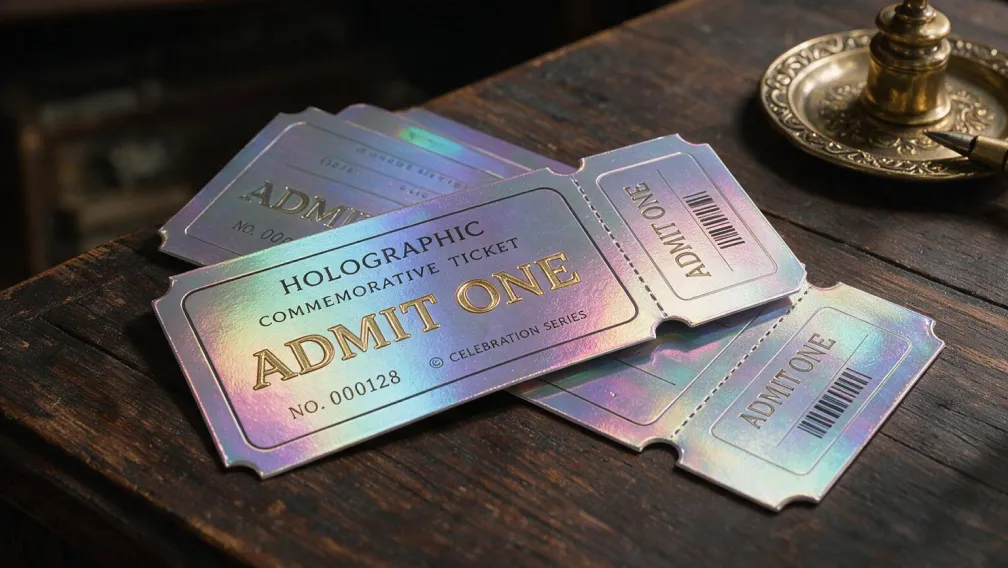
- Holographic and glitter laminates embed light-diffracting or reflective particles in the film itself, adding collectible appeal for limited runs and event exclusives.
- Soft-touch laminate adds a velvet texture that positions the sticker closer to a premium label than a giveaway item.
Waterproof claims should always be read as a laminate specification. A laminated vinyl sticker tolerates rain, condensation, and repeated washing; the same sticker without laminate is water-resistant at best. Dishwasher survival requires both a fully sealed laminate and an adhesive rated for sustained hot-water exposure, and honest suppliers will state that combination explicitly rather than apply a generic waterproof label to every product.
Adhesive Specification
Adhesive selection depends on the target surface and the intended service life. Permanent acrylic adhesive is the merchandise standard: it builds bond strength over 24 to 72 hours and holds on glass, metal, laminated paper, and most plastics for years. Removable adhesives sacrifice ultimate bond strength for clean, residue-free removal and suit temporary promotions, sample distribution, and reusable packaging. Two specification details deserve explicit confirmation on every order. The first is surface energy: powder-coated bottles and low-energy plastics reject standard adhesives and require high-tack formulations. The second is cold-temperature performance for programs shipping into winter markets, since standard acrylic adhesives stiffen and lose tack below their rated application temperature.
Artwork and Cut-Line Engineering
Sticker prepress failures are artwork failures in nearly every case. Production-ready files require a vector cut path on a separate layer, bleed extending 1.5 to 3 mm beyond the cut line so trimming never exposes unprinted edges, and a safe zone keeping text and critical detail at least 2 mm inside the cut path. Corner geometry matters as well: sharp external corners below roughly 1 mm radius are the first points to lift after application, so rounding them extends service life. Minimum line weights apply to kiss-cut sheets, where extremely thin connectors between design elements can tear during peeling. The layer structure, resolution, and color-mode requirements follow the same discipline documented in our acrylic keychain artwork setup guide, and the same 300 DPI print-ready standard applies here.
Verification Before Bulk Shipment
A qualified sticker program closes with testing, and buyers should expect a factory to state its verification steps without prompting. Standard checkpoints include a water immersion test on laminated samples, a cross-hatch adhesion test of the ink layer on each film lot, peel-adhesion measurement against the intended substrate, and accelerated UV exposure for outdoor-rated programs. Digital proofs should confirm the cut path, laminate, adhesive, and packing format before production, and production samples should be cut on the same plotters that will run the bulk order. Any deviation between sample and production equipment transfers avoidable risk to the buyer.
Specifying Your Program With Modori Works
Modori Works manufactures custom vinyl stickers for anime artists, merchandise brands, and retail programs, with production covering die-cut and kiss-cut formats, gloss, matte, and holographic laminates, and programs starting at one hundred pieces per design. Every order is proof-controlled: artwork, cut line, size, material, and packaging are confirmed on a digital proof before manufacturing begins. Submit your artwork with target quantity and intended application surface, and our team will return a material and format recommendation with a factory-direct quotation.
-

Modori Works Team
Custom B2B Merchandise Manufacturer
Authored by the engineering and production specialists at Modori Works. We share deep manufacturing insights, material breakdowns, and workflow guides to help global brands, artists, and event organizers bring custom acrylics, keycaps, and collectibles to life with strict IP protection.