Custom acrylic keychains remain one of the highest-volume SKUs in the anime merchandise, artist alley, and licensed collectibles sectors. For procurement managers and brand owners, the unit price of a printed charm is rarely the variable that determines project success. Defect rates, color consistency across reorders, compliance documentation, and lead time reliability are decided long before production starts, at the point of supplier selection.
This guide presents the evaluation framework used by professional buyers when qualifying a custom acrylic keychain manufacturer. It covers supplier classification, production infrastructure, printing specifications, certification verification, sampling protocol, and the pricing benchmarks that apply in 2026. The objective is to give B2B buyers a repeatable audit process that filters out unsuitable suppliers before a purchase order is signed.
Supplier Classification: Direct Factories vs. Trading Companies
The first screening step is confirming who will actually operate the machinery. China produces the majority of the world's custom acrylic merchandise, and the supplier pool includes vertically integrated factories, trading companies, and platform resellers. Each category behaves differently under production pressure.
Trading companies add a communication layer and a margin layer. They can be useful when a single order spans many product categories, but acrylic merchandise involves tolerances, ink behavior, and cutting parameters that require direct discussion with the technicians running the presses. When a sales intermediary relays artwork feedback to an unknown factory, revision cycles lengthen and error rates climb.
Verification is straightforward. Request the supplier's business license and check that the registered scope includes manufacturing, ask for a live video walkthrough of the production floor during working hours, and compare the facility against the equipment list they claim to operate. A factory will accommodate this within days; a reseller typically cannot.
Production Infrastructure and Capacity Assessment
Equipment Inventory
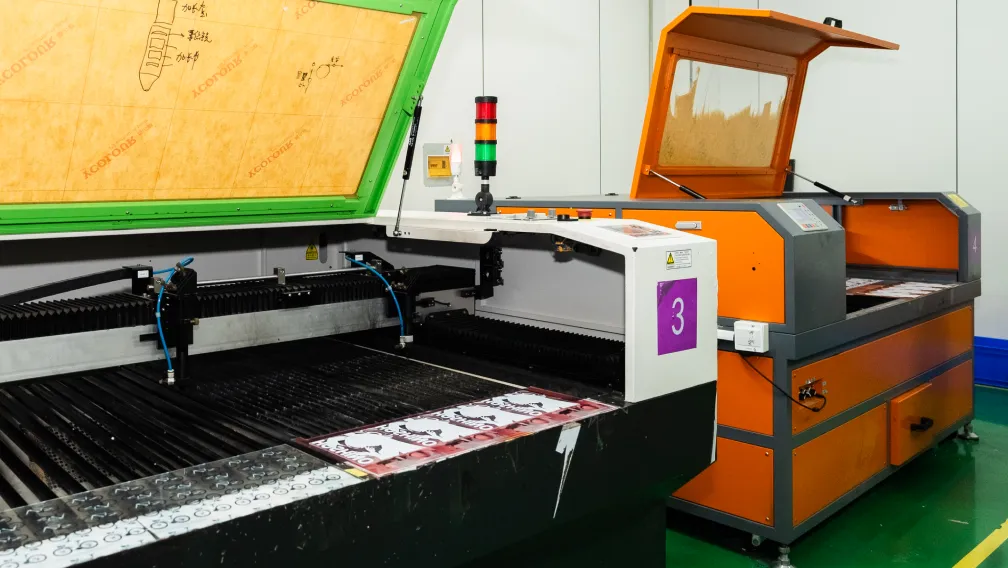
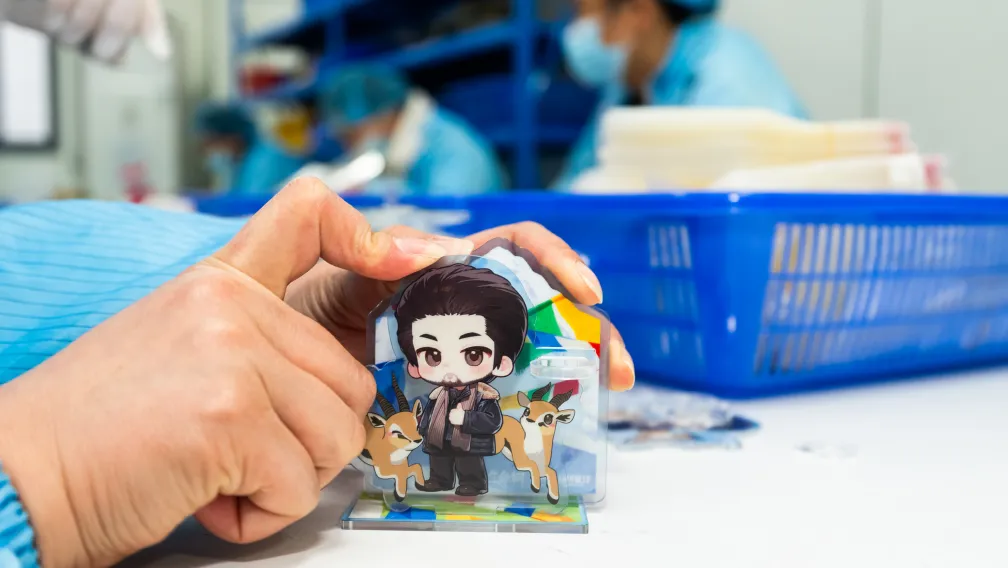
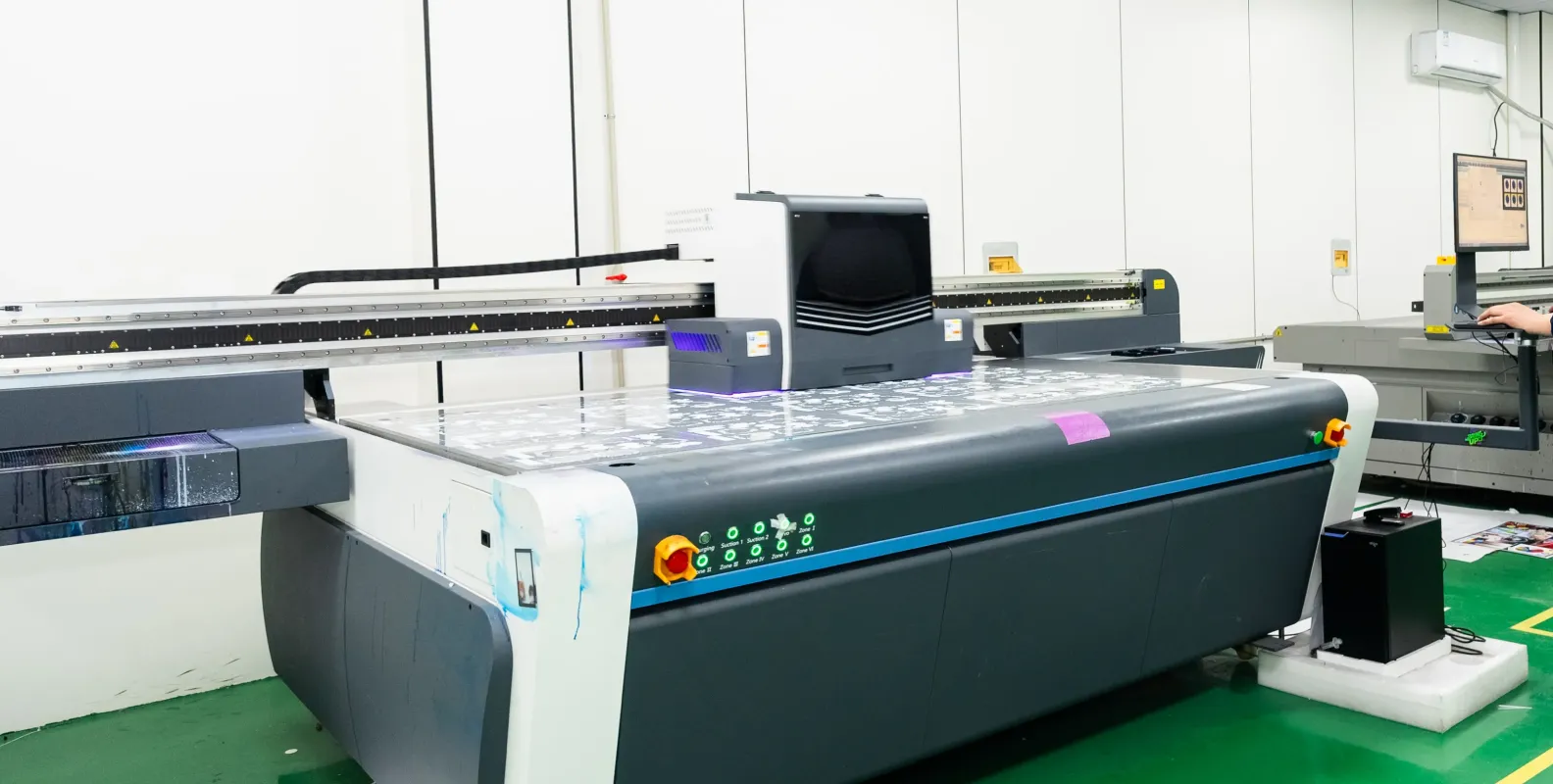
The equipment list is the most reliable predictor of what a supplier can produce without subcontracting. A complete acrylic merchandise operation requires industrial UV flatbed printers with CMYK plus white ink channels, laser and CNC cutting systems, edge polishing stations, hot stamping units, and assembly lines for hardware attachment. Suppliers who outsource any of these steps lose control over scheduling and over the intermediate quality checkpoints between processes.
Machine count matters for a different reason: lead time stability. A factory running a single UV printer will quote attractive delivery dates until a large order occupies the queue. Facilities operating dozens of machines across parallel lines can hold quoted lead times even during peak season. When auditing capacity, ask for the number of machines per process, daily output per line, and the current order backlog.
Facility Scale and Quality Staffing
Workshop area and staffing structure round out the infrastructure picture. Established acrylic merchandise factories typically operate facilities of 1,000 to 10,000 square meters with dedicated departments for printing, cutting, assembly, and quality control. The QC department deserves specific attention during an audit. Ask whether inspectors sit within the production line or report separately, what AQL sampling standard they apply, and what happens to rejected units. Our own production campus in the Yangtze River Delta runs more than 100 machines across four dedicated lines, and QC operates as a separate reporting line precisely so that output targets never override inspection results.
Material and Printing Specifications That Define Product Quality
PMMA Grade, Thickness, and Tolerance
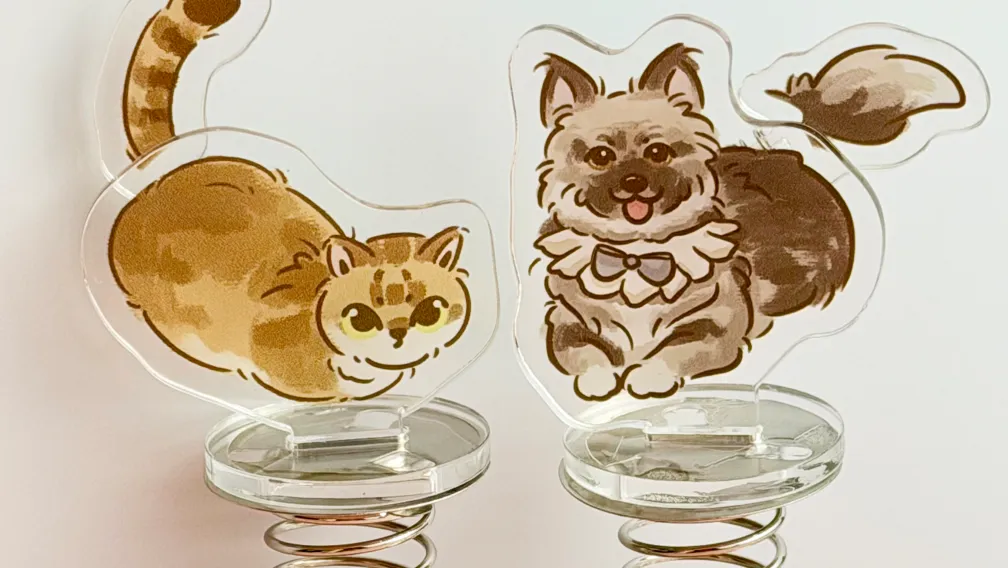
Acrylic merchandise uses polymethyl methacrylate in either cast or extruded form. Cast PMMA offers better optical clarity and superior laser-cutting behavior, which is why it dominates the collectibles segment. Standard commercial thickness for keychains ranges from 3.0 to 3.5 mm in laminated constructions, commonly a 2.5 mm printed layer bonded to a 1.0 mm protective layer. Dimensional deviation should stay within ±0.2 mm across a production lot. The measurement methods and acceptable deviation ranges are covered in detail in our article on industrial acrylic quality control tolerances, and any serious supplier should be able to state equivalent figures for their own output.
UV Printing Layer Architecture
Direct UV printing onto high-transparency film or sheet, cured instantly under ultraviolet lamps, is the process behind clear acrylic merchandise. Two technical points separate professional output from commodity output. The first is white ink management: artwork printed on transparent material requires a precisely registered white underbase, and misregistration of even 0.3 mm produces visible halos around character line art. The second is ink adhesion, which professional factories verify with cross-hatch tape testing on every material lot. Ask suppliers which adhesion standard they test against and how frequently they calibrate their white ink registration.
Cutting Precision and Edge Finish
Laser cutting produces the transparent polished edge associated with premium charms, while CNC routing suits thicker blocks and multi-layer assemblies. Diamond polishing is an additional step that removes micro-cutting marks on display-grade pieces. Beyond edge appearance, confirm the supplier's approach to hole diameter, hole position relative to the outline, and minimum bridge widths, since these parameters determine whether fine character details survive cutting. Artwork-side preparation for these constraints is documented in our acrylic keychain artwork setup guide, which buyers can circulate to their design teams before sampling.
Certifications and Compliance Verification
Certification claims require document-level verification. The relevant framework for acrylic merchandise manufacturing includes four categories:
- Quality management: ISO 9001 certification indicates documented process control. Request the certificate number and confirm it with the issuing body, and check that the certified scope covers the products you are ordering.
- Social compliance: BSCI and Sedex (SMETA) audits are standard requirements for European and North American retail programs. These audits cover labor conditions, working hours, and safety, and most licensed merchandise programs will not onboard a factory without them.
- Intellectual property authorization: For licensed character merchandise, Disney FAMA (Facility and Merchandise Authorization) is the reference standard. A FAMA-authorized facility has passed Disney's own compliance review, which provides strong third-party evidence of both labor standards and IP handling discipline.
- Material safety: RoHS and REACH test reports for PMMA sheet, inks, and metal hardware should be available from accredited third-party laboratories, dated within the last twelve months, and matched to the actual materials in your bill of materials.
The Sampling Protocol: Validating Capability Before Bulk Orders
Physical samples convert supplier claims into measurable evidence. A rigorous sample evaluation covers seven checkpoints:
- Color accuracy: Compare output against the approved digital proof and any specified Pantone references under standardized daylight lighting.
- Print registration: Inspect white ink alignment at the edges of line art and inside small enclosed shapes.
- Cut precision: Check that the outline follows the approved cut path without nicks at concave curves, and measure overall dimensions against the specification.
- Surface condition: Look for bubbles, embedded dust, scratches beneath the protective film, and cloudiness at the edges.
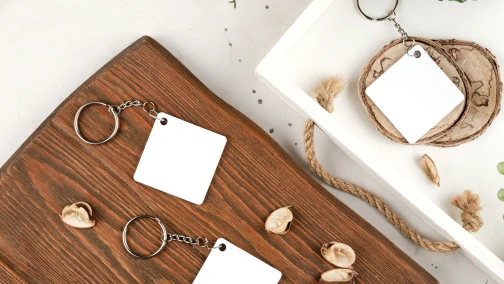
- Hardware quality: Test clasp spring tension, chain link closure, and plating uniformity on star, heart, or standard ring fittings.
- Protective film and packaging: Confirm that each unit ships with removable film and that packing prevents surface contact during transit.
- Structural durability: Flex the attachment point repeatedly and perform a drop test from desk height onto a hard surface.
Industry sampling lead times run approximately three days for standard constructions, with mass production of five to seven days after outline approval for small and medium runs. Suppliers quoting dramatically shorter timelines for first orders usually skip the proofing stage, which transfers risk to the buyer.
MOQ, Pricing, and Lead Time Benchmarks for 2026
The table below summarizes the commercial benchmarks that currently apply across qualified Chinese factories serving the anime merchandise segment. Figures vary with construction complexity, but any quote far outside these ranges warrants a closer look at what was excluded.
| Parameter | Industry Benchmark | What to Verify |
|---|---|---|
| Minimum order quantity | 50–500 pieces for OEM factory programs; 1–10 pieces at print-on-demand resellers | Whether the quoted MOQ includes free digital proofing |
| Sample lead time | ~3 working days | Whether samples are produced on production-line equipment |
| Mass production lead time | 5–7 days after outline approval; 10–15 days for 10,000+ unit runs | Peak-season capacity and current backlog |
| On-time delivery rate | ≥97% for established factories | Historical shipment data or third-party platform records |
| Dimensional tolerance | ±0.2 mm on thickness and outline | Incoming QC reports for PMMA sheet lots |
| Payment structure | 30% deposit, balance before shipment or against B/L copy | Terms in writing before deposit transfer |
Red Flags During Supplier Qualification
Certain patterns reliably predict project failure. Treat the following as disqualifying or, at minimum, as triggers for deeper investigation:
- Refusal to conduct a live video factory tour or to show the production floor during working hours.
- Pricing 30% or more below the market median without a documented explanation of which process step was removed.
- No written QC standard, or inability to state the AQL level applied to outgoing inspection.
- Certificates presented as unverifiable images without registration numbers.
- Samples produced by hand or on prototyping equipment that differs from the production line.
- Pressure to pay full balance before production, or reluctance to define lead time in the purchase contract.
Working With Modori Works
Modori Works operates a 10,000-square-meter production campus in China's Yangtze River Delta, running more than 100 machines across UV printing, CNC cutting, hot stamping, and badge pressing lines. The facility holds Disney FAMA authorization alongside ISO 9001, BSCI, and Sedex certifications, and serves merchandise programs across Japan, North America, and Europe.
Buyers evaluating custom acrylic keychains for retail or event programs can request material test reports, certification documents, and a production-line sample before committing to volume orders. The same evaluation framework applies to adjacent product lines, including custom acrylic standees and multi-layer acrylic shaker standees. Submit your artwork for a free engineering review, and our team will return a production feasibility assessment with cutting, printing, and finishing recommendations within one working day.
-

Modori Works Team
Custom B2B Merchandise Manufacturer
Authored by the engineering and production specialists at Modori Works. We share deep manufacturing insights, material breakdowns, and workflow guides to help global brands, artists, and event organizers bring custom acrylics, keycaps, and collectibles to life with strict IP protection.